Introduction
For businesses that depend on candles—stocking shelves in gift shops, setting ambiance in hotel lobbies, or fulfilling event orders—sourcing decisions have a direct impact on margins and supply consistency. Running short mid-season or overpaying per unit are avoidable problems. Bulk purchasing solves both.
Bulk candle purchasing isn't reserved for large retailers. Boutique gift shops, event planners, spas, and religious organizations are finding real value in it: lower per-unit costs, reliable supply, and the ability to scale without managing multiple vendors.
This article breaks down the practical, operational advantages of buying candles in bulk, who benefits most, and how to maximize the value of that decision.
Key Takeaways
- Bulk purchasing cuts per-unit cost by approximately 50%, protecting profit margins
- Ensures inventory stability and prevents stockouts during peak demand periods
- Maintains product consistency—same scent, quality, and appearance across every batch
- Supports faster scaling and product variety without sourcing complexity
- Frees up time and budget to focus on sales rather than repeated reordering
What Does Buying Candles in Bulk Mean?
Buying candles in bulk means purchasing finished candles in large quantities from a wholesale supplier at a significantly lower per-unit price than retail. The real advantage is in the wholesale pricing tiers — cost structures that make resale or high-volume operational use genuinely cost-effective.
Who buys candles in bulk?
- Gift shops and home décor retailers
- Spas, hotels, and restaurants (for ambiance)
- Event planners and wedding coordinators
- Religious organizations (for ceremonial use)
- Subscription box companies
- Convenience stores serving specific communities
Bulk buying is a supply strategy, not just a cost tactic. Locking in wholesale pricing before peak seasons — like holidays or wedding season — means your per-unit cost stays fixed even when retail demand (and retail prices) climb.
Standard bulk formats:
- Case packs of 12, 24, or 48 units per SKU
- Minimum order quantities (MOQs) typically range from 12 to 24 units per product
- Orders often structured around case multiples rather than individual units
Key Advantages of Buying Candles in Bulk
Lower Cost Per Unit
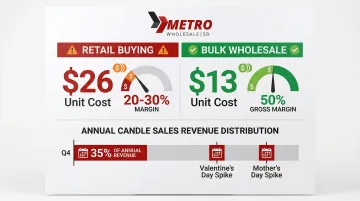
Wholesale pricing typically delivers candles at approximately 50% of retail price. A candle retailing for $26 costs around $13 at wholesale—a pricing structure that makes resale profitable and operational use affordable.
Why this matters:
- A 50% gross margin ($13 profit on a $26 sale) covers overhead, labor, and marketing — sourcing at retail leaves no room for profit
- Lower COGS supports competitive retail pricing, promotional markups, or gift-set bundling without squeezing margins
- During peak gifting periods, protected margins mean promotional discounts don't erase profitability
This advantage is most acute for high-turnover buyers — event planners, hotel chains, boutique retailers — and during peak gifting windows. 35% of candle sales occur during Q4 holidays, with secondary spikes around Valentine's Day and Mother's Day. For new product line launches, protecting those early margins is often what determines whether the line survives its first season.
Consistent Supply and Inventory Stability
Bulk purchasing creates a reliable stock buffer, reducing dependency on just-in-time ordering and the risk of running out during high-demand periods. Sourcing from one wholesale supplier also locks in consistency across scents, packaging, and lead times — details that matter more than buyers often expect.
Why this matters:
- Inventory distortion causes $1.73 trillion in annual losses globally — a stockout doesn't just lose the sale, it damages the relationship
- For spas, hotels, and subscription boxes, scent consistency is part of the brand promise; when it changes or disappears, guests notice
- 65% of consumers hold negative views of brands with regular stockouts, while high availability drives 30% higher repeat purchase rates
The stakes are highest for subscription-based models, event-driven orders with fixed lead times, and seasonal demand spikes — situations where a substitute product simply isn't an option. Inventory fill rate and customer retention rate move together in these contexts; one directly affects the other.
Scalability and Product Flexibility
Bulk buying enables businesses to scale candle offerings faster — either by increasing volume of best-sellers or by introducing new varieties without sourcing from multiple suppliers. Wholesale suppliers typically offer broader catalogs (different wax types, scent families, container styles) that become more accessible at scale.
Why this matters:
- A gift shop stocking everyday candles alongside seasonal collections can respond to trend shifts without overhauling its supply chain
- Fewer, larger orders reduce packaging waste and delivery trips — shipment consolidation can cut carbon emissions by 10.3%, which matters for businesses with sustainability commitments
- The candle market is growing at 7.3% CAGR through 2033, with premium candles ($31–70) growing at 10.1% annually — bulk buying positions retailers to move quickly as demand shifts
This flexibility pays off most when growing a product mix, launching coordinated seasonal campaigns across multiple SKUs, or responding to fast-moving trends — eco-friendly wax, wellness-focused scents, and premium fragrances are all areas where early positioning translates to higher average transaction values.
What Happens When You Skip Bulk Buying
Businesses relying on frequent small purchases typically pay retail or near-retail premiums per unit, which cuts directly into margins. Instead of a 50% gross margin, they're often left with 20–30%—leaving little room after overhead. That squeeze also makes it harder to compete on price or run promotions without going negative.
Operational Disruption from Inconsistent Sourcing
Beyond the margin hit, frequent small-batch ordering creates day-to-day friction that compounds over time:
- Fragrance or quality variations between small batches undermine brand consistency
- Unpredictable lead times complicate inventory planning
- Repeated reorders from multiple vendors consume staff time
- Managing multiple supplier relationships adds administrative overhead
Compounding Risk During Peak Seasons
The 2021 holiday season illustrated this clearly — supply chain disruptions forced retailers to accept whatever stock they could secure, often at inflated prices. Businesses without advance bulk orders faced:
- Supplier delays or complete unavailability of popular scents
- Price surges as suppliers prioritized larger, committed buyers
- Missed sales opportunities during the most profitable weeks of the year
- Customer dissatisfaction when promised products weren't available
The Revenue Cost of Stockouts
Industry data suggests products experiencing stockouts remain unavailable for an average of 35 days. For candles — where roughly 35% of annual sales occur in Q4 — a month-long gap during November–December erases revenue that simply can't be recovered later in the year.
How to Get the Most Value from Buying Candles in Bulk
Plan Around Real Demand
Review sales trends, seasonal peaks, and customer preferences before placing large orders. Allocate budget to proven performers first—don't spread it uniformly across all SKUs.
Key planning steps:
- Analyze historical sales by SKU, season, and customer segment
- Identify your top 20% of products (typically generating 80% of revenue)
- Calculate safety stock levels based on lead time and demand variability
- Factor in promotional calendars and seasonal events

Choose a Supplier You Can Count On
Work with a wholesale partner that publishes clear pricing tiers, meets fill rates reliably, and carries the specific product mix you need. Metro Wholesale stocks religious candles, scented varieties, and specialty options in standard 12-pack case configurations—making it straightforward to forecast reorder quantities and maintain steady supply.
Supplier evaluation criteria:
- Product consistency meeting safety standards (ASTM F2417 for fire safety, ASTM F2058 for labeling)
- Reliable lead times and high fill rates
- Transparent MOQs and pricing tiers
- Responsive customer support
- Breadth of catalog (scents, wax types, container styles)
Treat Bulk Buying as an Ongoing Process
The biggest mistake retailers make is placing a large order once and repeating it blindly. Review actual consumption and sell-through data each cycle, then adjust per-SKU quantities before the next order—not after overstock accumulates.
Adjustment tactics:
- Track sell-through rates by SKU weekly during peak seasons
- Reduce quantities on slow movers before they become overstock
- Increase allocations to fast sellers before stockouts occur
- Test new products in smaller initial quantities before committing to full cases
Conclusion
The core value of buying candles in bulk comes down to three interconnected advantages: lower per-unit costs that protect margins, consistent supply that prevents stockouts, and the flexibility to scale as demand grows.
Bulk purchasing works best as an ongoing sourcing strategy, not a one-time transaction. Revisit your order volumes regularly against sales performance, seasonal demand, and supplier terms. The businesses that get the most out of wholesale buying are those that treat it as a deliberate part of their inventory planning — not just a way to cut costs when margins get tight.
Frequently Asked Questions
What are the benefits of candles?
Candles serve multiple purposes across settings—creating ambiance, delivering aromatherapy benefits, supporting brand identity, and enhancing mood. This versatility drives consistent demand across personal and commercial settings alike.
What types of businesses benefit most from buying candles in bulk?
Retailers, spas, hotels, event planners, subscription box companies, and religious organizations commonly buy candles in bulk. Any business that resells candles or uses them regularly in operations benefits from wholesale pricing and supply consistency.
How much can you save by buying candles in bulk vs. retail?
Wholesale candle pricing typically runs at around 50% of retail price. A candle retailing for $26 would cost roughly $13 at wholesale—a margin difference that adds up quickly at volume.
Is there a minimum order quantity (MOQ) when buying candles in bulk?
Yes, MOQs typically range from 12 to 24 units per SKU. Confirm MOQs upfront and factor them into cash flow planning, since most suppliers structure orders around case pack multiples.
How do I choose the right bulk candle supplier?
Evaluate suppliers on product quality consistency, fragrance range, pricing transparency, lead times, and customer support. Verify they meet safety standards and can maintain reliable supply during peak demand periods.
Can individuals buy candles in bulk for events or personal use?
Yes, bulk buying isn't exclusive to businesses. Individuals planning weddings, parties, or large gatherings often benefit from bulk pricing on candle orders, especially when uniform appearance and scent matter across multiple tables or venues.