Introduction
Professional cleaning clients judge quality by results — and results depend entirely on showing up with the right tools, chemicals, and equipment. Running back for a forgotten product or grabbing the wrong chemical for a surface doesn't just waste time; it can cost you the client. According to the Bureau of Labor Statistics, the janitorial sector faces an injury rate of 86.6 days-away-from-work cases per 10,000 full-time workers, with 87.6% of chemical exposure cases requiring time off. Proper equipment and safety protocols aren't optional — they're core to running a profitable operation.
This guide breaks down what every cleaning business needs to stock: basic tools, cleaning chemicals, specialized equipment, PPE, and smart sourcing strategies. Whether you're launching a residential service or scaling a commercial operation, knowing what to buy, and how to buy it efficiently, is what separates businesses that grow from ones that stall.
Key Takeaways
- Microfiber cloths, mops, vacuums, scrub brushes, and spray bottles form the foundation of every job
- Cleaning chemicals must match the surface and task — all-purpose cleaners, disinfectants, and degreasers each cover different situations
- Specialized equipment like steam cleaners and carpet machines separates standard services from premium offerings
- Stock PPE — gloves, masks, and non-slip shoes — to protect your crew and signal professionalism to clients
- Buying in bulk from a wholesale distributor like Metro Wholesale reduces per-unit cost and keeps jobs from stalling when supplies run short
Basic Cleaning Tools and Equipment
This starter kit applies whether you serve residential homes or commercial spaces. The right tools cut job time, protect worker health, and produce results clients can see — and remember.
Handheld and Surface Tools
Microfiber cloths are the workhorse of professional cleaning. Studies show microfiber removes 95% of microbes with detergent, compared to just 68% for cotton, and they trap dust, bacteria, and debris without scratching surfaces. They're washable and reusable, cutting down on chemical-heavy products. Color-code by zone — red for bathrooms, blue for general areas, green for kitchens — to prevent cross-contamination.
Other essential handheld tools include:
- Spray bottles for diluting concentrated chemicals
- Scrub brushes in varying bristle strengths for different surfaces
- Squeegees for windows and shower glass
- Sponges and toilet brushes for bathroom work
- Extendable dusters for high shelves and ceiling fans
Floor Cleaning Equipment
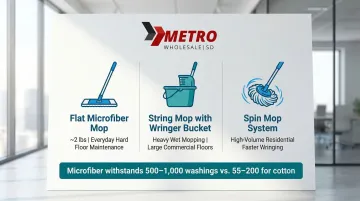
Choose your mop system based on floor type and job volume:
- Flat microfiber mops — everyday hard floor maintenance, lightweight and fast
- String mops with wringer buckets — heavy wet mopping on large commercial floors
- Spin mop systems — faster wringing for high-volume residential jobs
Microfiber mops are lighter (around 2 lbs vs. 10 lbs for cotton), reduce worker fatigue, and withstand 500–1,000 washings compared to just 55–200 for cotton.
Vacuum cleaner requirements for professional use:
- HEPA filtration to capture 99.97% of particles at 0.3 microns — critical for allergy-sensitive homes and required for certain commercial contracts
- Multiple attachments including crevice tools and upholstery brushes
- Corded commercial-grade units for heavy-duty jobs or lightweight cordless models for residential agility
Organization and Transport Gear
Keeping supplies organized on the job speeds up each room and cuts down on backtracking. Useful transport and storage items include:
- Caddies for grouping room-specific supplies (glass cleaner, bathroom products, etc.)
- Stackable bins in the van to separate clean tools from used ones between jobs
- Portable buckets with dividers so crews carry everything needed for one floor at a time
A well-stocked caddy also signals professionalism — clients notice when a crew arrives organized rather than making repeated trips to the vehicle.
Essential Cleaning Chemicals and Solutions
The right chemicals — matched to the surface and the job — protect client property, deliver consistent results, and reduce labor time. More chemicals is not better; a focused chemical kit is more efficient and safer.
Everyday Multi-Surface Cleaners
All-purpose cleaner is the most-used product for countertops, appliances, walls, and non-porous surfaces. A quality concentrated formula diluted into spray bottles is far more cost-effective than pre-diluted retail versions. Switching to concentrates can reduce the cost per spray bottle from $2.00-$10.00 (ready-to-use) to just $0.50-$1.00.
For high-touch areas like door handles, light switches, and bathroom fixtures, a disinfectant spray or solution is non-negotiable. EPA-registered formulas are the standard, especially for commercial contracts or medical-adjacent settings. Check the EPA's List N for products effective against SARS-CoV-2 to meet client expectations for pathogen control.
Round out the everyday kit with a dedicated glass cleaner for windows, mirrors, and glass surfaces — streak-free results are one of the first things clients notice.
Specialty and Surface-Specific Cleaners
Beyond the everyday essentials, certain jobs demand purpose-built formulas. Bathroom and toilet bowl cleaner breaks down limescale, soap scum, and mildew without the grout or fixture damage that general cleaners can cause over time.
Kitchen jobs require a heavy-duty degreaser. Commercial-grade formulas cut through cooking grease on stovetops, range hoods, and appliances far more effectively than any all-purpose cleaner.
Surface-specific solutions:
- Wood cleaner/polish for furniture and hardwood floors
- Stainless steel cleaner for appliances and fixtures
- Carpet spot remover for stain treatment between deep cleans
Eco-friendly formulas are also worth stocking. The global green cleaning products market reached $37.56 billion in 2024 and is projected to grow at 14.1% CAGR through 2034. Clients willing to pay for plant-based, low-VOC service packages are a growing segment — and one that can support higher per-visit rates.
Specialized and Heavy-Duty Equipment
Specialized equipment allows a cleaning business to win higher-value contracts and stand out from solo operators. While not all items are needed at launch, knowing what to add as you scale is essential.
Steam cleaner — uses heat and pressure to sanitize without chemicals, making it effective for tile grout, upholstery, kitchen appliances, and bathrooms. Steam at 90°C (194°F) achieves complete inactivation of SARS-CoV-2 within 2 seconds. That translates directly to reduced chemical costs while still meeting client expectations for deep sanitation.
Carpet cleaning machine (portable or upright extractor) is essential for deep carpet cleaning, move-in/move-out cleans, and commercial floor care. Commercial extractors feature high water lift and airflow to pull moisture out effectively — residential units often leave carpets damp and aren't built for continuous use.
For businesses pursuing janitorial contracts, two pieces of indoor equipment open doors to larger accounts:
- Floor buffer/polisher — maintains hard floors in offices, retail spaces, and medical facilities. Most commercial janitorial contracts include floor care as a recurring line item.
- Wet/dry vacuum — handles liquid spills, construction debris, and post-event cleanup; complements the extractor for any job involving wet surfaces.
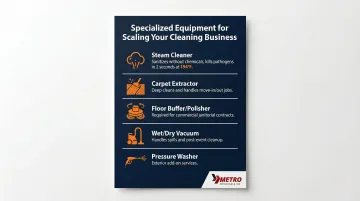
Once indoor services are established, exterior work offers a natural expansion path. A pressure washer covers driveways, patios, building facades, and parking lots — add-on services that can meaningfully increase revenue per client without requiring a new customer base.
Personal Protective Equipment (PPE) for Your Crew
PPE is non-negotiable. It protects your crew's health, limits your liability, and shows clients you run a serious operation. A team that shows up with the right safety gear signals they know what they're doing.
Core PPE items:
- Disposable latex-free gloves for standard tasks
- Heavy-duty rubber gloves for chemical-heavy work
- Safety goggles or face shields when using concentrated cleaners or pressure equipment
- N95 or respirator masks for dusty environments or strong chemical applications (note: N95s filter airborne particles but do not protect against chemical vapors)
Supporting safety items:
- Non-slip footwear to prevent falls on wet surfaces
- Waterproof aprons or coveralls to protect clothing during heavy-duty jobs
- Wet floor signs and caution cones for compliance and liability protection
- Stocked first aid kit for every vehicle
Stocking this gear also keeps you compliant. OSHA requires employers to assess workplace hazards and provide appropriate PPE, with written documentation of that assessment. If your crew uses respirators, additional requirements apply: medical evaluation, annual fit testing, and crew training are all mandatory.
Smart Buying Tips: How to Source Cleaning Supplies Efficiently
The smartest cleaning businesses don't just buy the right supplies — they buy them the right way. Purchasing strategy directly affects profit margins, especially as supply needs multiply across crews and locations.
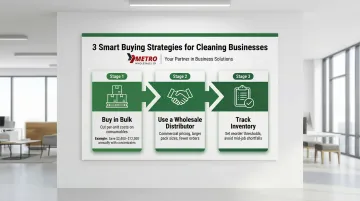
Three practices make the biggest difference in how efficiently you source supplies:
Buy in bulk. Microfiber cloths, trash bags, disinfectant, and gloves are high-frequency consumables — buying them in case quantities rather than retail cuts per-unit cost significantly. One case study found a hotel chain saving $12,300 annually and a restaurant saving $2,400 by switching to concentrated chemicals.
Work with a wholesale distributor. Wholesale suppliers offer commercial pricing and larger pack sizes, which reduces how often you're placing small, expensive orders. Metro Wholesale carries bulk case quantities of cleaning essentials — microfiber cloths, trash bags, disinfectants, degreasers, and gloves — through a member-based pricing system built for commercial buyers.
Track inventory to avoid shortfalls. A simple restocking system — even a spreadsheet — lets you monitor usage rates per job, spot which products run out fastest, and set reorder thresholds before you're caught short. For multi-crew operations, setting minimum stock levels ensures supplies are always on hand without over-ordering.
Frequently Asked Questions
What supplies do I need for a cleaning business?
You need five core categories: basic tools (mops, microfiber cloths, vacuum, brushes), cleaning chemicals (all-purpose, disinfectant, degreaser, glass cleaner), specialized equipment (steam cleaner, carpet machine for premium services), PPE (gloves, masks, goggles), and organizational gear (caddies, trash bags, spray bottles).
What is the 20/10 rule for cleaning?
The 20/10 rule is a time management method: clean actively for 20 minutes, then take a 10-minute break. Professional cleaning businesses adapt it by organizing tasks room by room to maintain efficiency across a full-day schedule.
How much does it cost to stock supplies when starting a cleaning business?
A basic starter kit (mop system, vacuum, handheld tools, essential chemicals) can run several hundred dollars, while a fully equipped setup with specialized equipment (carpet extractor, steam cleaner, commercial vacuum) can reach several thousand. Purchasing wholesale and starting with essentials before adding specialized equipment keeps startup costs manageable.
What is the difference between residential and commercial cleaning supplies?
Residential jobs typically require lighter-duty tools and consumer-grade chemicals, while commercial contracts often require industrial-grade equipment (floor buffers, commercial vacuums with continuous-duty motors, EPA-registered disinfectants) and larger supply volumes to handle higher square footage and stricter compliance standards.
Should I provide my own cleaning supplies or use the client's?
Most professional cleaning businesses supply their own products for consistency, quality control, and professionalism. This is factored into service pricing and ensures you're working with products you have proper safety data for — a requirement for OSHA compliance.
How often should I restock cleaning supplies for my business?
Track usage per job and set minimum reorder thresholds so you're buying before you run out. Bulk purchasing from a wholesale supplier like Metro Wholesale lowers per-unit costs, and setting par levels ensures you never hit a mid-job shortfall.