Introduction
Bathrooms are among the highest-traffic, highest-germ areas in any home or facility — yet most people underestimate how much the right cleaning supplies matter. Harmful bacteria can persist on toilet surfaces for up to 50 days, and public restroom studies show that 91.3% of toilet door handles carry bacterial contamination. Using the wrong products on the wrong surfaces doesn't just waste time and money — it can permanently damage fixtures or create safety hazards through accidental chemical reactions.
This guide covers what you need to choose and use bathroom cleaning supplies effectively — whether you're stocking a single household bathroom or managing multiple commercial facilities. Here's what's inside:
- Best products by category, from disinfectants to scrubbing tools
- How to match supplies to surface type and soil level
- The difference between cleaning and disinfecting (and when each matters)
- What to avoid with common challenges like soap scum, hard water, and mold
Key Takeaways
- Five product categories cover every bathroom cleaning job: toilet bowl cleaners, shower/tub cleaners, all-purpose sprays, disinfectants, and the right tools
- Match products to specific soils—soap scum, hard water deposits, and mildew each require different chemical approaches
- Never mix bleach with ammonia or vinegar—both combinations release toxic gases
- Switching from ready-to-use to concentrated formulas can cut costs by up to 15 times for commercial buyers
- EPA registration is mandatory for any product claiming to disinfect—cleaning and disinfecting are legally distinct actions
Overview of Bathroom Cleaning Supplies
Bathroom cleaning supplies encompass both chemical cleaners formulated for specific surfaces and soils, plus physical tools like brushes, cloths, and squeegees. Bathrooms demand specialized products due to their unique combination of moisture, bacteria, hard water deposits, soap scum, and mold/mildew risk—a combination rarely found in any other room.
The bathroom cleaning products market reflects this complexity. The global household cleaning products market is projected to reach $170.47 billion in 2026, driven by growing consumer awareness of household hygiene, with 85% of consumers intending to maintain elevated cleaning practices long-term. The bathroom-specific segment is growing even faster, with specialized products commanding premium pricing due to their targeted formulations.
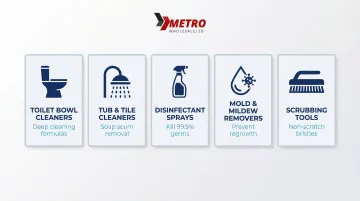
The five categories below cover the most essential bathroom cleaning supplies:
- Toilet bowl cleaners — formulated to dissolve mineral deposits and kill bacteria
- Tub and tile cleaners — target soap scum and hard water buildup on large surfaces
- Disinfectant sprays — broad-surface germ control for counters, sinks, and fixtures
- Mold and mildew removers — penetrating formulas for grout and caulk lines
- Scrubbing tools — brushes, cloths, and squeegees that make cleaners more effective
Best Bathroom Cleaning Supplies
Products were evaluated for cleaning efficacy, surface compatibility, safety profile, value, and availability for both consumer and commercial/bulk use.
Toilet Bowl Cleaners
Toilet bowl cleaners are formulated to dissolve limescale, mineral deposits, and kill bacteria in hard-to-reach areas under the rim. Options range from gel or liquid poured under the rim to dissolvable tablets and disposable wand systems. Each format offers different trade-offs between convenience, contact time, and cost per use.
Disinfecting certification is the key differentiator to check first. Only EPA-registered products can legally claim to "disinfect"—a critical distinction since toilet bowls harbor bacteria that can persist for 50 days. Equally important is whether the formula is safe for septic systems, as harsh chemicals can kill essential bacteria in septic tanks and cause system failure.
Key Features Comparison:
| Key Feature | What to Look For |
|---|---|
| Disinfecting Power | EPA-registered disinfectant status that kills bacteria and viruses, not just cleans |
| Surface Compatibility | Safe for porcelain; verify septic-safe certification if applicable |
| Form Factor | Gel under-rim liquid (best dwell time), dissolvable tablet (convenience), or disposable wand system (no brush needed) |
Metro Wholesale stocks Scrub Free Toilet Bowl Cleaner in wholesale 12/16oz cases, along with disposable Clorox Bath Wand systems for facilities requiring no-touch cleaning solutions.
Shower & Tub Cleaners
Shower and tub cleaners must tackle three distinct problems—soap scum, hard water/mineral deposits, and mold/mildew—and no single formula excels equally at all three. Spray formulas offer versatile wide coverage, gels dwell longer on vertical grout lines, and foams work well for large flat surfaces like tub bottoms.
Hard water affects a significant portion of U.S. households, with water classified as "hard" at 121-180 mg/L calcium carbonate and "very hard" above 180 mg/L. Hard water minerals react with soap to create insoluble soap scum that adheres stubbornly to shower walls, requiring acidic cleaners for effective removal.
However, those same acidic formulas will permanently etch natural stone surfaces like marble or travertine — a surface compatibility check that matters before purchasing.
Surface compatibility is the most important filter when choosing a shower cleaner: confirm the formula is safe for your specific surfaces — ceramic tile, porcelain, fiberglass, glass, and grout — and note whether natural stone is explicitly excluded. Speed of action and whether the product requires scrubbing or can simply be sprayed and rinsed round out the evaluation.
Key Features Comparison:
| Key Feature | What to Look For |
|---|---|
| Target Soil | Check label to confirm whether formula targets soap scum, hard water deposits, or mildew—most specialize in one or two |
| Surface Compatibility | Safe for ceramic tile, porcelain, fiberglass, glass, and grout; note if natural stone is explicitly excluded |
| Form Factor | Spray (versatile coverage), gel (better dwell on grout/vertical surfaces), or foam (good for large flat surfaces) |
All-Purpose Bathroom Cleaners
All-purpose bathroom cleaners are designed for countertops, sinks, faucets, and exterior toilet surfaces. They bridge the gap between targeted cleaners and disinfectants, making them the workhorse of routine cleaning between deep-clean sessions.
The most important distinction to check: does the product both clean and disinfect? A cleaner removes visible dirt through chemical or physical action, while a disinfectant is EPA-registered to kill specific pathogens at a required dwell time. Some products do both, but many do only one.
Also consider fragrance options for enclosed spaces with limited ventilation, and whether the formula leaves streaks or residue on chrome and porcelain.
Key Features Comparison:
| Key Feature | What to Look For |
|---|---|
| Dual-Action Capability | Clean + disinfect formulas with EPA registration versus clean-only products |
| Scent/Safety Profile | Fragrance-free versus lightly scented; relevant for bathrooms with minimal ventilation or users with chemical sensitivities |
| Residue & Finish | Streak-free performance on chrome and porcelain; no filmy residue on countertops |
Metro Wholesale carries Awesome brand all-purpose cleaners and window cleaners in bulk 12/32oz cases, suitable for daily bathroom surface maintenance.
Disinfecting Wipes & Sprays
Disinfecting wipes and sprays are engineered for high-touch surfaces—faucet handles, toilet flush levers, light switches, door handles—where quick sanitization between deep cleans matters most. Research confirms that flush levers are contaminated in 50% of public restrooms, serving as primary vectors for fecal-oral disease transmission.
"Disinfecting" requires a product to be EPA-registered and to remain wet on a surface for the required contact time. The surface must stay visibly wet for the entire dwell period—if it dries before the time is up, the product must be reapplied. Typical contact times range from 30 seconds to 10 minutes depending on the pathogen and formula.
For high-frequency cleaning, the format decision comes down to volume: wipes are pre-moistened with no prep required, making them the faster option for daily touch-ups, while trigger sprays with cloths cost less per square foot and scale better in high-volume settings. Commercial and multi-bathroom facilities often default to bulk-dispensed wipes for speed and consistency across staff.
Key Features Comparison:
| Key Feature | What to Look For |
|---|---|
| Kill Claims | Verify EPA registration number on label for specific bacteria, viruses, and fungi claims |
| Format | Pre-moistened wipes (fast, no prep) versus trigger spray + cloth (more economical for high-volume use) |
| Contact/Dwell Time | Required wet contact time—faster dwell time (30 seconds to 2 minutes) is more practical for high-frequency cleaning than 10-minute requirements |
Metro Wholesale stocks Clorox Disinfecting Wipes in 12/35ct wholesale cases, providing 420 wipes per case for facilities managing multiple bathrooms.
Bathroom Cleaning Tools
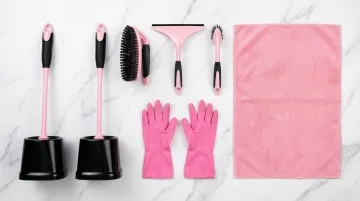
Even the best chemical cleaners underperform without the right tools. A complete bathroom toolkit covers:
- Toilet brush with under-rim design for reaching bacteria below the waterline
- Extendable tub/tile scrubber with stiff bristles for grout lines and high wall tiles
- Microfiber cloths — lint-free, non-scratching on porcelain and chrome
- Squeegee for glass shower doors and mirrors
- Detail brush set for faucets and tight crevices
Professional-grade tools stand out from consumer options through durability of bristles, ergonomic handle design for reduced fatigue, and materials that don't harbor bacteria between uses. Silicone toilet brushes are non-porous and naturally resistant to picking up germs, while traditional nylon bristles are porous and hold onto oils, debris, and bacteria even after rinsing.
Key Features Comparison:
| Feature Category | What to Look For |
|---|---|
| Core Tools | Toilet brush (under-rim design), extendable tub scrubber, microfiber cloths, squeegee, detail brush set |
| Material Quality | Silicone or stiff nylon bristles, non-scratch microfiber, rust-resistant handles—professional-grade tools last significantly longer than consumer equivalents |
| Where to Source | For facilities or bulk buyers managing multiple bathrooms, wholesale suppliers like Metro Wholesale offer commercial-grade tool sets at reduced per-unit cost compared to retail |
Metro Wholesale carries FamilyMaid toilet brushes with holders in 12-unit cases, plus specialized scrub brushes for tubs and tiles in bulk configurations.
How to Choose the Right Bathroom Cleaning Supplies
The most common buying mistake is choosing products based on scent or brand recognition alone, rather than matching the formula to the specific soil type and surface material. This results in poor outcomes, wasted product, and in some cases permanent surface damage.
Surface Compatibility Matters
Ceramic tile, porcelain, and fiberglass each have different tolerances for acidic or abrasive cleaners. Always check product labels for surface exclusions, particularly for natural stone. Marble, limestone, and travertine are highly sensitive to acids: even mild acids like vinegar or lemon juice will etch the surface, leaving permanent dull spots that require professional refinishing. Never use bathroom cleaners, grout cleaners, or tub & tile cleaners containing acid on natural stone.
Cleaning vs. Disinfecting: A Legal Distinction
A product that removes visible dirt does not necessarily kill pathogens, and a disinfectant does not necessarily remove soap scum or mineral deposits. For a bathroom, you often need both, either in one dual-action formula or as a two-step process.
EPA regulations define these terms precisely:
- Cleaning physically removes dirt and organic matter using soap or detergent
- Sanitizing reduces germs to levels considered safe by public health codes (requires EPA registration)
- Disinfecting chemically destroys or inactivates bacteria, viruses, and fungi (requires EPA registration and rigorous testing)
Chemical Safety: What Must Never Be Mixed
Choosing the right products also means knowing what cannot be combined. Mixing common bathroom chemicals can produce lethal gases, which is why labeled, single-purpose cleaners reduce risk in shared cleaning environments.
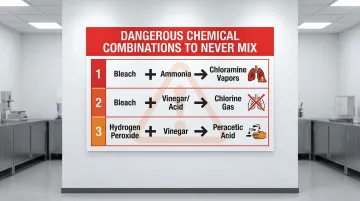
Never mix these combinations:
| Combination | Reaction Product | Health Hazard |
|---|---|---|
| Bleach + Ammonia | Chloramine vapors | Coughing, nausea, shortness of breath, pneumonia, fluid in lungs |
| Bleach + Vinegar/Acidic Cleaners | Chlorine gas | Severe respiratory damage, chest pain, vomiting, potential fatality |
| Hydrogen Peroxide + Vinegar | Peracetic acid | Highly corrosive; irritates skin, eyes, and respiratory tract |
Cost-Per-Use for Commercial Buyers
For commercial and bulk buyers, factor in cost-per-use rather than sticker price. Ready-to-use products are approximately 15 times more expensive than concentrated formulas, and aerosol products can cost up to 27 times more than concentrates.
A concentrated formula diluted on-site delivers 5-10× more cleaning solution per dollar than ready-to-use retail formats.
Concentrates also cut shipping weight and storage requirements. A 1:128 dilution ratio product reduces shipping weight from approximately 2,000 lbs (ready-to-use) to just 16 lbs (concentrate) for the same usable volume, a major logistics advantage for facilities managing multiple locations.
Conclusion
A well-equipped bathroom cleaning kit comes down to matching the right products to the right surfaces and using them consistently. The five categories covered here handle routine maintenance, deep cleaning, and disinfection across every bathroom surface and soil type — without unnecessary overlap or redundancy.
For facilities, property managers, or households maintaining multiple bathrooms, buying cleaning supplies in bulk through a reliable wholesale source cuts costs and eliminates the hassle of constant reordering. Wholesale case quantities keep shelves stocked, and commercial-grade formulations tend to stretch further per dollar than standard retail options.
To stock up on professional-grade bathroom cleaning supplies at wholesale prices, Metro Wholesale offers case-quantity options for retail buyers and bulk purchasers. Get in touch through any of the channels below:
- Website: Browse the Metro Wholesale product catalog
- Email: info@metrowholesalesd.com
- Phone: +1 619-423-5600
Frequently Asked Questions
What are the must-have bathroom cleaning supplies every home or facility should stock?
Five categories cover the essentials:
- Toilet bowl cleaner (EPA-registered disinfectant formula)
- Shower/tub cleaner matched to your water hardness and soil type
- All-purpose disinfecting cleaner for countertops and sinks
- Disinfecting wipes or spray for high-touch surfaces
- Core tools: toilet brush, microfiber cloths, scrub brush, and squeegee
What is the difference between a cleaner and a disinfectant for bathroom use?
Cleaners remove dirt, grease, and residue through chemical or physical action. Disinfectants are EPA-registered products proven to kill a specific percentage of pathogens when the surface stays wet for the required dwell time. Some products do both, but many only clean without disinfecting—check the EPA registration number on the label to verify disinfectant claims.
What bathroom cleaning chemicals should never be mixed together?
Never mix bleach with ammonia (produces toxic chloramine gas), bleach with vinegar or acidic cleaners (releases chlorine gas), or hydrogen peroxide with vinegar (creates corrosive peracetic acid). All three combinations can cause severe respiratory damage, chemical burns, or fatality. Use single-purpose, clearly labeled products to prevent accidental mixing.
How often should bathroom cleaning supplies be restocked or replaced?
Restock liquid cleaners before running out to avoid hygiene gaps. Replace tools on a schedule: toilet brushes every 6 months, microfiber cloths when absorption declines, and scrub brushes when bristles fray. Silicone toilet brushes outlast nylon and can extend that interval considerably.
Are eco-friendly or natural bathroom cleaners as effective as chemical-based ones?
Plant-based cleaners now match conventional formulas for routine maintenance, but may need longer dwell time or extra scrubbing on mold or heavy hard water buildup. For disinfection claims, eco-friendly products must still carry EPA registration regardless of their natural ingredients.
How do I choose the right cleaner for different bathroom surfaces?
Check product labels for surface compatibility before applying anything new. Avoid acidic cleaners on natural stone (marble, granite, travertine) and use non-abrasive formulas on chrome and fiberglass—acidic cleaners tackle hard water deposits well on porcelain and ceramic, but must never contact stone. When in doubt, pH-neutral formulas are the safest multi-surface choice.