
Introduction
You're rushing out the door for an important meeting when you reach for your deodorant—only to find an empty tube. Or you're brushing your teeth at night and squeeze out the last bit of toothpaste, realizing there's no backup in the cabinet. These frustrating moments are more common than most people realize. Personal care supplies are daily-use consumables that households consistently underestimate, leading to last-minute store runs and paying full retail price instead of stocking up at a discount.
The financial impact adds up quickly. In 2024, U.S. households spent an average of $978 on personal care products and services, a 2.9% increase from the prior year. With the personal care market projected to reach $108.19 billion by 2026, knowing what to keep stocked — and how much — can cut that annual bill noticeably.
This guide covers the essential personal care categories to keep stocked, how much to buy, and how to store them properly. The goal: fewer emergency store runs, smarter purchasing, and less money wasted on convenience-priced single units.
Key Takeaways
- Oral care, hair care, body care, and hygiene products are daily necessities that deplete faster than most people plan for
- Strategic stockpiling saves money and eliminates emergency store trips
- Buying in bulk reduces per-unit cost significantly, with packages twice the size carrying a 30% lower unit price on average
- Store products in cool, dry locations (not bathrooms) to maximize shelf life
- Rotate stock using oldest products first and replenish at 25-30% remaining
Why Stocking Up on Personal Care Supplies Is Worth It
Proven Financial Benefits
Buying personal care supplies in larger quantities consistently lowers per-unit cost. Research shows that a package twice the size typically has a 30% lower unit price compared to smaller formats. For low-income households, adopting bulk purchasing behaviors similar to high-income households could save approximately 5% annually on groceries, with similar savings applying to personal care items.
The numbers add up fast when you look at the full picture:
- 87% of shoppers have changed purchasing habits due to inflation, with bulk buying being a top strategy
- The average household spends nearly $1,000 annually on personal care products
- A 10–15% reduction through strategic bulk buying saves $100–$150 per year

Convenience That Eliminates Stress
Beyond the savings, there's a practical upside that's easy to overlook. Running out of toothpaste or deodorant mid-week means an unplanned errand at full retail price. A stocked household eliminates this problem — you grab what you need and move on.
Preparedness for Supply Disruptions
The COVID-19 pandemic revealed how quickly basic hygiene products can disappear from shelves. In March 2020, the FDA had to issue temporary guidelines to address hand sanitizer shortages.
By 2022, CVS and Walgreens confirmed that suppliers could not fulfill orders for tampons and pads. A buffer supply at home provides real security when shelves run thin again.
Essential Personal Care Supplies to Stock Up On
These categories cover the personal care items households go through at predictable rates — which makes them practical candidates for bulk purchasing and advance stocking. Knowing shelf lives, storage requirements, and regulatory expiration rules helps buyers purchase confidently without waste.
Oral Care
What to stock: Toothpaste, toothbrushes (manual or replacement heads for electric), dental floss, and mouthwash — all used daily and depleted at predictable rates.
Oral care items are well-suited for bulk purchasing for several reasons:
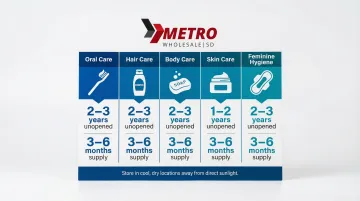
- Most have a 2–3 year shelf life when unopened
- Products are compact and easy to store in quantity
- Prices fluctuate seasonally, so buying on sale locks in savings
Because fluoride toothpaste is regulated as an OTC drug, manufacturers must include expiration dates to ensure the fluoride remains stable and effective.
| Shelf Life (Unopened) | Recommended Stock Level | Storage Tip |
|---|---|---|
| Toothpaste: ~2 years; Mouthwash: 2-3 years; Toothbrushes: indefinite | 3-6 months per household member | Store in a cool, dry cabinet away from humidity |
Metro Wholesale carries major oral care brands including Listerine (Cool Mint, Fresh Brush, Original), Colgate (Cavity Protection, Triple Action, Sparkling White), Crest, and Amoray floss picks — all available in wholesale case quantities that make bulk purchasing practical for families and businesses.
Hair Care
What to stock: Shampoo, conditioner, and regularly used styling or treatment products (dry shampoo, leave-in conditioner, hair oils). Usage rate varies significantly by hair type and household size.
Liquid hair care products are dense and heavy, so buying larger bottle formats or multi-packs from wholesale suppliers offers both cost and convenience advantages. Warehouse club pricing for bulk shampoo can be as low as $0.39 per fluid ounce, significantly lower than standard retail sizing.
| Shelf Life (Unopened) | Recommended Stock Level | Buying Tip |
|---|---|---|
| Shampoo/conditioner: 2-3 years; Opened: 12-18 months | 2-4 bottles per person | Look for bulk-format or salon-size bottles through wholesale channels |
Hair care products are regulated as cosmetics, meaning expiration dates are not federally mandated — though most manufacturers include shelf-life guidance on the packaging.
Body Care
What to stock: Body wash or bar soap, hand soap (liquid or bar), deodorant/antiperspirant, and body lotion. These are used daily by every household member, making depletion rates high and predictable.
One important distinction: antiperspirants are regulated as OTC drugs because they affect body function (reducing sweat) and must carry expiration dates, typically 1–3 years. Deodorants are regulated as cosmetics and don't require expiration dates.
| Shelf Life (Unopened) | Recommended Stock Level | Cost-Saving Approach |
|---|---|---|
| Bar soap: 2-3 years; Body wash: ~2 years; Deodorant: 1-3 years | 3-6 months based on household size | Multi-pack body soap and hand soap refills offer best per-unit value |
Check expiration windows before buying large quantities of antiperspirants, especially for less frequently used formulations. Bar soap and body wash have longer, more forgiving shelf lives.
Skin Care Essentials
What to stock: Facial moisturizer, sunscreen, petroleum jelly (multi-use), and lip balm — items often overlooked in stockpiling but used regularly enough to warrant keeping extras on hand.
Sunscreen requires special attention. As an OTC drug, the FDA requires that sunscreen remain at original strength for at least three years. If a sunscreen lacks an expiration date, write the purchase date on the bottle and discard after three years. Don't over-stock beyond a 1-2 year window to avoid expiry waste.
| Shelf Life (Unopened) | Recommended Stock Level | Versatility Note |
|---|---|---|
| Petroleum jelly: 3-5 years; Sunscreen: 2-3 years (per expiry); Lip balm: 1-5 years | Keep 2-3 units of high-use items; limit sunscreen to avoid expiry | Petroleum jelly doubles as chapped skin remedy, barrier cream, and minor wound protector |
Petroleum jelly has an exceptionally long shelf life because it's anhydrous — containing no water — making it unlikely to support bacterial growth.
Feminine Hygiene and Shaving Supplies
What to stock: Sanitary pads, tampons, liners (or reusable alternatives), razors, shaving cream or gel, and aftershave products.
Feminine hygiene products are non-perishable, compact, and essential — they are among the first items to clear shelves during supply disruptions. During the pandemic, charitable organizations reported a 52% drop in tampon donations in early 2022 compared to 2021, making them a high-priority stockpile item.
| Shelf Life (Unopened) | Recommended Stock Level | Storage Tip |
|---|---|---|
| Pads/tampons: indefinite if stored dry; Razors: indefinite; Shaving cream: ~2 years | 3-6 months of feminine hygiene products; 2-3 packs of razors or blades | Keep in sealed bags or bins to protect from moisture, especially in humid bathrooms |
Tampons are regulated as medical devices by the FDA, but the FDA does not mandate expiration dates. They are non-perishable when stored in dry conditions.
How to Build a Smart Personal Care Stockpile
Start with a Household Inventory
List every personal care product your household uses regularly, note the approximate monthly consumption per person, and identify which items run out fastest. This baseline prevents over-buying products that won't be used and under-buying high-turnover items.
Track for one month:
- Which products you replace most frequently
- How many people use each product
- Whether usage is daily, weekly, or occasional
Apply the Buy-Ahead Rule
Rather than waiting until a product is fully depleted, purchase a replacement when the current supply drops to roughly 25-30% remaining. This ensures a buffer without excessive accumulation. That 25-30% threshold is your household reorder point: low enough to justify restocking, high enough to avoid running out mid-week.
Prioritize by Usage Rate and Shelf Life
Best candidates for bulk purchasing:
- High-frequency, long-shelf-life products: toothpaste, bar soap, feminine hygiene products
- Items with stable formulations: petroleum jelly, dental floss, razors
Buy in smaller quantities:
- Short-shelf-life items: opened shampoo, antiperspirants nearing expiry
- Specialty products: prescription-adjacent skincare, medicated shampoos
Leverage Wholesale Advantages
For retail buyers and business operators sourcing personal care supplies at volume, working with a wholesale distributor like Metro Wholesale brings per-unit costs well below standard retail pricing. This matters most for operations that go through high-turnover essentials quickly.
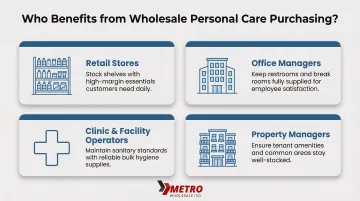
Common use cases include:
- Retail stores restocking shelves on predictable cycles
- Office managers stocking shared restrooms and breakrooms
- Clinic and facility operators buying in consistent monthly quantities
- Property managers supplying guest amenities across multiple units
Metro Wholesale carries case-pack quantities — typically 6-pack, 12-pack, or 24-pack configurations — on brands like Colgate, Listerine, Dove, and Huggies.
Use Sales Cycles Strategically
Most personal care products go on promotion seasonally—tracking sale patterns and buying 3-6 months of supply at the lowest price point is an effective way to reduce annual spending. Major retail events like Black Friday and back-to-school seasons often feature cross-promotions on personal care items.
Pro tip: Keep a simple spreadsheet noting when your favorite products go on sale, then plan your bulk purchases around these windows.
Where and How to Store Your Personal Care Supplies
Choose the Right Storage Location
Most personal care products perform best stored in a cool, dry location away from direct sunlight and humidity. The bathroom is convenient but often the worst storage environment due to heat and steam.
Better storage options:
- Linen closet or hallway cabinet
- Bedroom closet shelf
- Climate-controlled garage cabinet
- Dedicated stockroom shelving (for sealed, case-packed items)
These location choices matter more than most buyers expect. High heat and humidity accelerate the breakdown of preservatives and active ingredients — toothpaste can separate and liquefy in heat, while sunscreen should never be stored in direct sunlight or warm environments like delivery vehicles.
Implement a FIFO Rotation System
Always place newly purchased products behind or below existing stock, so the oldest items are used first. This First-In, First-Out (FIFO) method prevents waste from products expiring before use and keeps your inventory rotating properly.
Simple rotation process:
- When restocking, move older items to the front
- Place new purchases at the back
- Check expiration dates quarterly
- Use products with nearest expiry dates first

Organize for Visibility and Access
Use labeled bins, stackable drawers, or dedicated shelving to keep categories separated and visible. A well-organized inventory is easier to monitor, reducing the risk of running out or over-ordering.
Organization strategies:
- Clear bins for easy visual inventory checks
- Labels by category (Oral Care, Hair Care, Body Care)
- Separate bins for each household member if needed
- Keep frequently used items at eye level
Conclusion
The average household spends close to $1,000 a year on personal care products — stocking up strategically turns that spending into a real advantage. Lower per-unit costs, fewer last-minute store runs, and zero risk of running out make it one of the simplest supply chain improvements a household or small retailer can make.
The best approach is gradual. Start with the highest-use categories — oral care and body care — then establish a rotation habit and expand over time as storage and budget allow.
Buying from wholesale suppliers rather than retail can cut per-unit costs by 30% or more, meaning the stockpile essentially pays for itself over a few months.
Metro Wholesale supplies quality personal care products in bulk case quantities at wholesale pricing. Reach the team at info@metrowholesalesd.com or call +1 619-423-5600 to explore available products and current pricing.
Frequently Asked Questions
What essentials should you stock up on?
Focus on the core personal care categories: oral care (toothpaste, toothbrushes, floss), hair care (shampoo, conditioner), body care (soap, deodorant), skin care (moisturizer, sunscreen), feminine hygiene, and shaving supplies. Prioritize the categories your customers replace most frequently and that move fastest off your shelves.
Do personal care products expire?
Yes, most personal care products have shelf lives, typically 1-3 years when unopened. Expiration dates are usually printed on packaging, especially for items regulated as drugs (fluoride toothpaste, antiperspirants, sunscreen). Products like petroleum jelly and bar soap tend to last significantly longer than liquid formulas.
How much of each personal care product should I keep stocked at home?
A general guideline for retail buyers is maintaining a 4-8 week floor stock for high-velocity items like toothpaste, body wash, and deodorant. Scale order quantities to your store's sell-through rate, and review sales data monthly to refine reorder points by category.
Is buying personal care supplies in bulk worth it?
Yes, bulk buying typically reduces per-unit cost — packages twice the size often carry a 30% lower unit price. It's particularly cost-effective for non-perishable or long-shelf-life items, and case-quantity purchasing through a wholesale distributor compounds those savings further, protecting your store's margins on everyday essentials.
What is the best way to store personal care supplies?
Store in a cool, dry stockroom away from heat and humidity. Keep categories organized with labeled shelving and rotate inventory using the FIFO method (First-In, First-Out) so older units move to the sales floor first, minimizing expiry waste and shrinkage.
How often should I replenish my personal care stockpile?
Replenish when existing stock reaches 25-30% remaining. Check expiration dates during each replenishment cycle to confirm proper rotation. Align larger purchases with seasonal promotions (Black Friday, back-to-school) for maximum savings.